

Key Takeaways
- The purchase price is only one component of what an item actually costs you.
- Cheap products often require earlier replacement, erasing any upfront savings.
- Cost-per-use is a more reliable metric than sticker price for most buying decisions.
- Some categories reward frugality; others punish it with compounding hidden costs.
- Matching purchase quality to expected usage frequency reduces long-term spending.
Our Verdict
Cheap purchases can genuinely save money in the right context — low-stakes, single-use, or easily replaceable items are fair candidates. But for anything used daily, tied to safety, or likely to incur maintenance costs, skimping on upfront price often costs more by the second or third replacement cycle. The smartest approach isn't always spending more — it's calculating the real cost over the product's useful life before you buy.
Consumers who want to stretch their budget without triggering regret-driven repurchases — especially those evaluating mid-to-high-frequency everyday items.
Why the Sticker Price Is Only the Starting Point
Every purchase carries two price tags: the one on the shelf and the one that accumulates over time. The shelf price is easy to see. The lifetime cost — factoring in maintenance, replacement frequency, energy use, and performance degradation — rarely appears on any label.
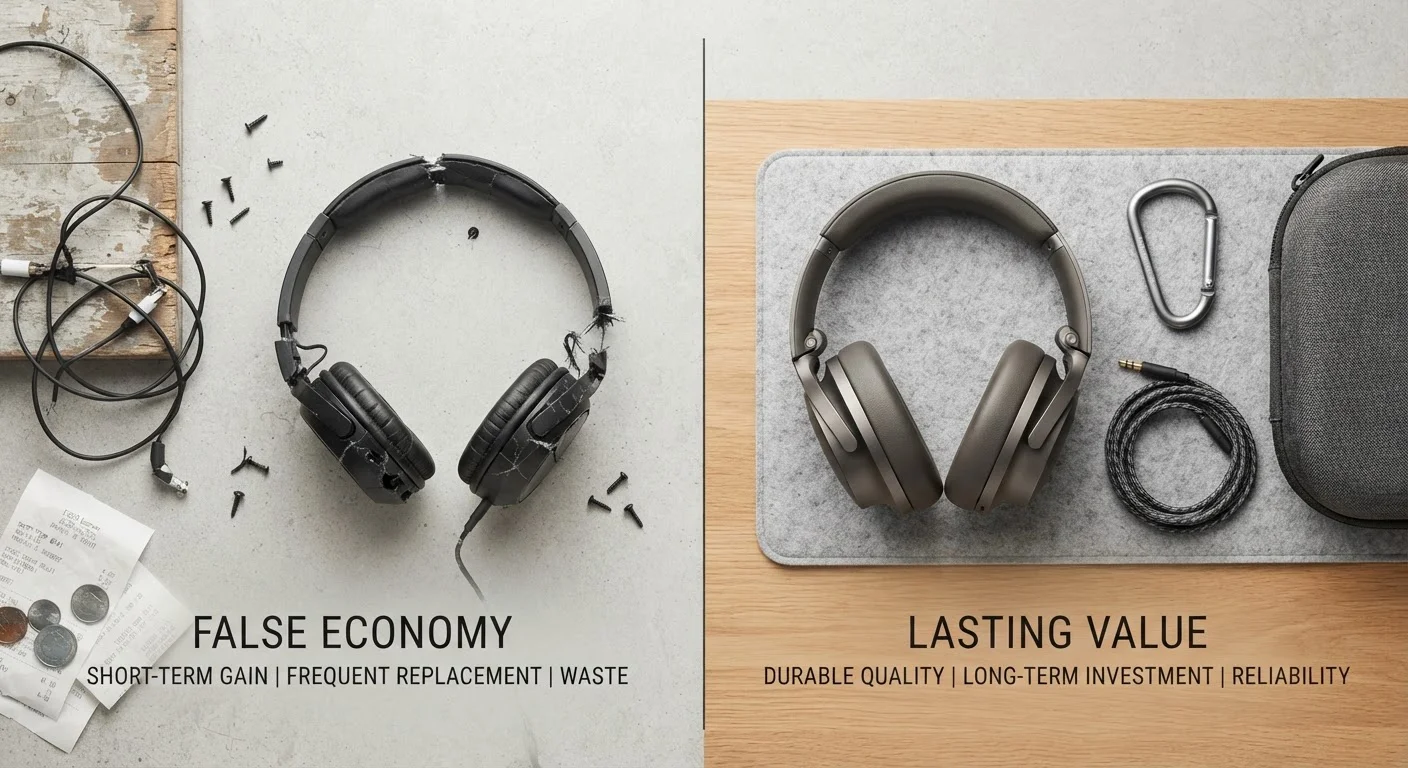
This gap is where cheap purchases quietly become expensive ones. A $15 item that lasts three months costs more annually than a $40 version that lasts three years. Understanding this math is the foundation of smarter spending, and it applies across virtually every product category — from shoes and appliances to tools and electronics.
For a broader look at how hidden costs stack up in specific contexts, this breakdown of value vs. cheap walks through cost-per-use, durability, and replacement frequency in useful detail.
Where Cheap Purchases Work Against You
The costs of a budget purchase don't always show up immediately. They tend to surface gradually — through performance that degrades faster, parts that wear out sooner, or safety margins that weren't built in. These patterns are especially pronounced in a few key categories.
Tools and appliances are among the most common culprits. A lower-cost version may lack the motor tolerance or component quality to handle consistent use, meaning it breaks down well before a pricier alternative would. Repair costs, when available, can rival the original purchase price. The same logic applies to home maintenance decisions, where skimping early compounds into larger expenses later.
Safety-related items — car seats, helmets, electrical components — represent a different calculation entirely. Underspending here isn't just a financial risk; it's a safety risk. This isn't a category where cost-cutting typically makes sense.
Footwear and outerwear are another area where cheap purchases often backfire. Poorly constructed shoes can wear down in months, while a better-made pair may stay functional for years with basic care.
When Buying Cheap Is the Smarter Move
Frugality isn't always a false economy — sometimes it's the genuinely rational choice. The key is matching purchase quality to actual need.
For items used infrequently or for a narrow purpose, spending more may simply mean paying for durability you'll never use. A party decoration, a single-use craft supply, or a seasonal item that gets deployed twice a year doesn't need to last a decade. Buying cheap in these situations is financially sound.
Similarly, items in categories that evolve quickly — certain electronics, software accessories, trend-driven fashion — may be obsolete before a cheap version would wear out. Paying a premium for longevity in a product category defined by rapid turnover can actually be the worse financial decision.
The trade-offs of secondhand vs. new shopping reflect a similar tension: lower upfront cost can be wise or wasteful depending entirely on the item and how you'll use it.
A Simple Framework for Evaluating Any Purchase
Before any significant purchase, three questions cut through most of the noise:
- How often will I use this? Daily-use items justify higher upfront investment. Occasional-use items rarely do.
- What does replacement cost, really? Factor in your time and hassle, not just the next purchase price. Repurchasing something three times is rarely just three times the original price.
- What's the cost per use? Divide the purchase price by a reasonable estimate of how many times you'll use it. This single metric often flips the apparent value of a cheap vs. quality option.
This framework also scales to larger decisions. The principles behind car ownership costs most drivers overlook are essentially the same logic applied to a much larger purchase: the visible cost is rarely the full cost.
If you're working within a tight budget, foundational budgeting strategies can help you identify which categories have the most room for quality investment and which can absorb more frugal choices without consequence.