

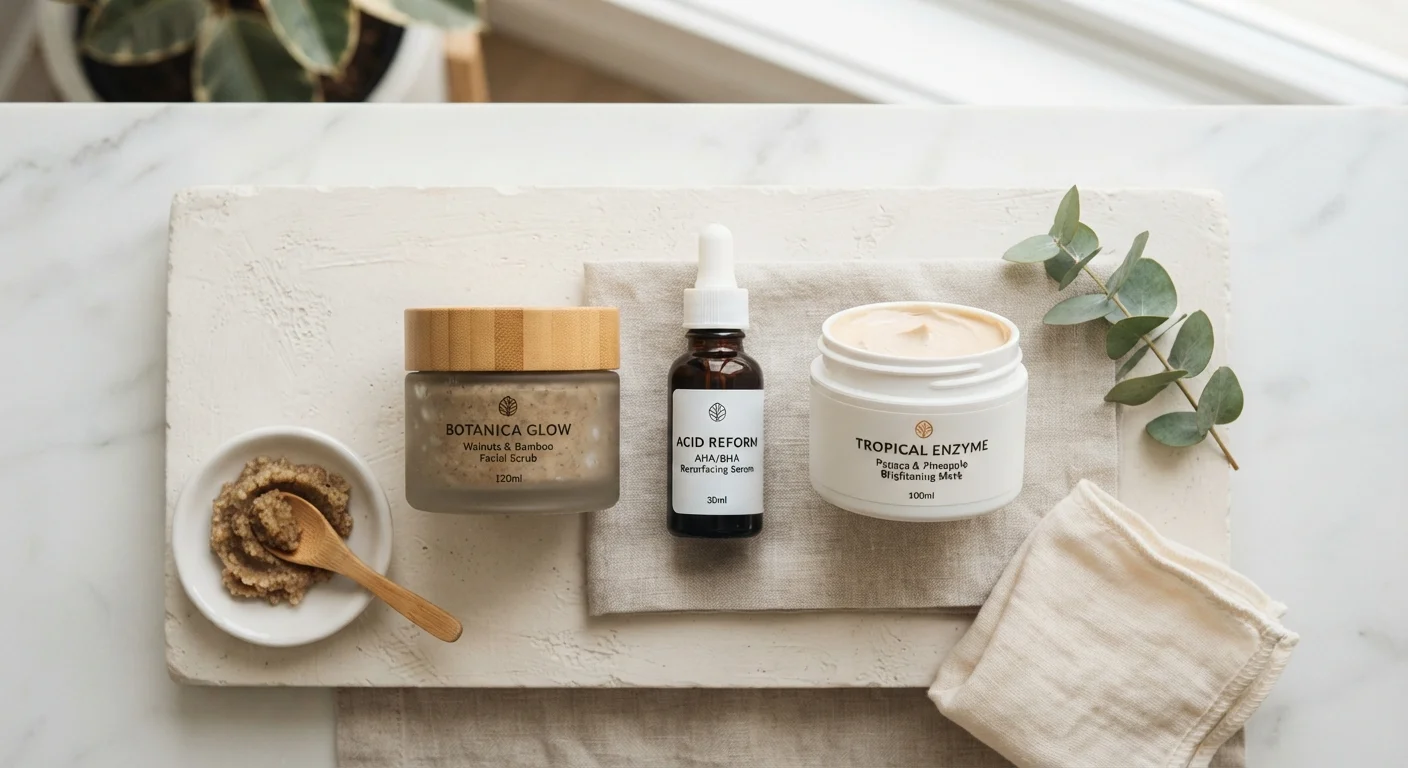
Key Takeaways
- Physical exfoliants use friction to manually buff away dead skin cells.
- Chemical exfoliants like AHAs and BHAs dissolve the bonds holding dead cells together.
- Enzymatic exfoliants use fruit-derived proteins to digest surface debris gently.
- Your skin type is the single most important factor when choosing an exfoliation method.
- Over-exfoliating — with any method — can damage your skin barrier.
Our Verdict
No single exfoliation method is universally superior. Physical exfoliants offer immediate tactile results but demand a careful touch. Chemical exfoliants deliver consistent, deeper cell turnover for a range of skin concerns. Enzymatic options occupy a gentle middle ground ideal for reactive skin. Matching the method to your skin type and tolerance is what truly determines results.
| Best for | Recommended |
|---|---|
| Normal or resilient skin seeking immediate smoothness | Physical exfoliation |
| Oily, acne-prone, or skin with uneven texture or hyperpigmentation | Chemical exfoliation |
| Sensitive, reactive, or rosacea-prone skin | Enzymatic exfoliation |
| Beginners building a first exfoliation habit | Enzymatic exfoliation |
Why Exfoliation Actually Matters
Skin naturally sheds dead cells every 28 to 40 days, but that cycle slows with age, stress, and environmental exposure. When dead cells accumulate, pores can clog, texture turns rough, and moisturizers struggle to absorb effectively. Exfoliation speeds up the removal of that surface layer — but the method you choose determines how aggressively, how deeply, and how safely that happens.
Before diving in, it helps to know your skin type. Our guide to grooming routines across skin types is a solid starting point if you're unsure where your skin falls.
| Physical | Chemical | Enzymatic | |
|---|---|---|---|
| How it works | Friction removes surface cells | Acids dissolve cell bonds | Enzymes digest dead cells |
| Speed of results | Immediate smoothness | Gradual over weeks | Subtle, near-immediate |
| Best skin types | Normal, combination | Oily, acne-prone, uneven tone | Sensitive, reactive |
| Penetration depth | Surface only | Surface to pore-level (BHA) | Surface only |
| Sun sensitivity risk | Low | Moderate to high (AHA) | Low |
| Beginner-friendliness | Moderate — technique matters | Moderate — start low concentration | High — very forgiving |
| Frequency guideline | 1–2x per week | 2–3x per week | 1–2x per week |
Physical Exfoliation: Scrub It Away
Physical exfoliants work through mechanical action — meaning friction. A granular scrub, a facial brush, or a textured cloth physically dislodges dead skin cells from the surface. The results are immediate: skin feels smoother the moment you rinse off.
The catch is control. Coarse particles or heavy-handed scrubbing can create micro-tears in the skin, disrupt the moisture barrier, and worsen conditions like active acne or rosacea. Finer, rounder particles — such as those in sugar-based or jojoba bead formulas — are generally gentler than irregular shapes like crushed walnut shells.
Choose Particle Shape Over Grit
When selecting a physical scrub, look for round, uniform particles rather than jagged or irregular ones. Round particles slide across skin with less trauma, reducing the risk of micro-abrasions. If you're shaving regularly, physical exfoliation can complement that routine — our comparison of electric razors vs. manual blades is worth a read for the full picture.
Physical exfoliation is best used one to two times per week and is generally well-suited to normal, combination, or resilient skin types. Those with sensitive or acne-prone skin should approach with caution or skip it altogether.
Chemical Exfoliation: Dissolve the Bond
Rather than scrubbing cells away, chemical exfoliants use acids to break the bonds that hold dead skin cells together, allowing them to shed more naturally. The two main categories are:
- AHAs (alpha-hydroxy acids) — such as glycolic and lactic acid — work primarily on the skin's surface. They're well-researched for smoothing texture, fading dark spots, and improving radiance. Lactic acid tends to be milder and is often recommended for drier or more sensitive skin.
- BHAs (beta-hydroxy acids) — salicylic acid being the standout — are oil-soluble, meaning they can penetrate into pores. This makes them particularly effective for oily and acne-prone skin.
Chemical exfoliants require patience — visible results often build over several weeks. Sun sensitivity is a real consideration with AHAs in particular, so daily SPF use becomes non-negotiable. For a deeper look at how these compare to scrubs, see our article on chemical exfoliants vs. physical scrubs.
Enzymatic Exfoliation: The Gentle Third Option
Enzymatic exfoliants use naturally occurring proteins — most commonly derived from papaya (papain) or pineapple (bromelain) — to digest dead skin cells at the surface. Unlike acids, they don't alter skin pH. Unlike scrubs, there's no friction involved.
This makes them the most beginner-friendly option and often the right choice for sensitive, reactive, or rosacea-prone skin. Results tend to be subtler than chemical or physical methods, and they work best as a rinse-off mask rather than a leave-on formula.
Watch for Fruit Allergies
Enzymatic exfoliants derived from papaya or pineapple can trigger reactions in people with sensitivities or allergies to those fruits. Always patch-test a new enzyme product on a small area of skin and wait 24 hours before applying it to your full face. If irritation, redness, or itching occurs, discontinue use and consult a dermatologist.
Enzymatic exfoliants are typically used once or twice per week. They pair well with a straightforward routine — understanding skincare layering order can help you slot them in correctly without neutralizing their effect.
Getting Your Frequency and Timing Right
Regardless of which method you choose, more is rarely better when it comes to exfoliation. Over-exfoliating strips the skin's protective barrier, leading to redness, flaking, tightness, and increased sensitivity. General guidance suggests one to three sessions per week for most people, with sensitive skin types staying on the lower end.
If you're switching exfoliation methods or adding one to your routine for the first time, introduce it slowly. Our self-check before switching your skincare routine can help you evaluate whether a change is timely — or premature.
This article is for general informational purposes only and is not a substitute for professional skincare or medical advice. If you have a skin condition or concerns about a new product, consult a licensed dermatologist.