

Key Takeaways
- Casual and business casual are distinct codes, but the exact boundary depends heavily on your specific workplace culture.
- Business casual generally means neat, intentional dressing — think polished fabrics, clean fits, and minimal distressing.
- Casual allows more self-expression but still has limits in most workplaces — logos, graphic tees, and athletic wear often cross the line.
- When in doubt, dressing one level up from what you think is expected is almost always the safer choice.
- Fit and fabric condition matter more than garment type — a well-fitted chino reads more professional than a wrinkled dress shirt.
Option A
Casual Dress
The relaxed, personal-expression end of the spectrum.
Best for: Off-duty days, creative studios, remote work, and workplaces with explicitly relaxed or no dress code.
Option B
Business Casual
The polished-but-approachable middle ground most offices expect.
Best for: Client-facing roles, corporate environments, hybrid offices, and any setting where professionalism is implied.
If your office has no written dress code and your team wears hoodies daily
Casual Dress
In truly relaxed workplace cultures, over-dressing can feel out of sync. Match your environment, but keep clothing clean and in good repair.
If you're meeting clients, attending job interviews, or presenting to leadership
Business Casual
First impressions and professional moments call for polished, intentional dressing that signals effort and respect for the setting.
If your office uses the term 'business casual' without defining it
Business Casual
Default to the more polished interpretation until you observe what colleagues actually wear day-to-day and adjust accordingly.
If you work remotely but attend occasional in-person team days
Business Casual
In-person touchpoints carry more social weight than daily remote work; stepping up your look on those days shows awareness of the shift.
Why These Two Codes Keep Getting Confused
American workplaces have quietly dismantled the old three-tier dress hierarchy — formal, business, casual — and replaced it with a blurry spectrum that leaves a lot of people guessing. The rise of remote and hybrid work accelerated this shift dramatically, and many offices that once had clear guidelines have simply stopped updating them.
The result: "business casual" is now one of the most searched and most misunderstood dress-code terms in the country. And "casual" has expanded so much that it covers everything from a lived-in graphic tee to a clean linen shirt. Knowing where one ends and the other begins is less about memorizing rules and more about reading context — though some core principles hold up across almost every environment.
For a broader foundation on building a wardrobe that handles this kind of everyday flexibility, The Complete Guide to Everyday American Style is a useful starting point.
What Each Code Actually Looks Like
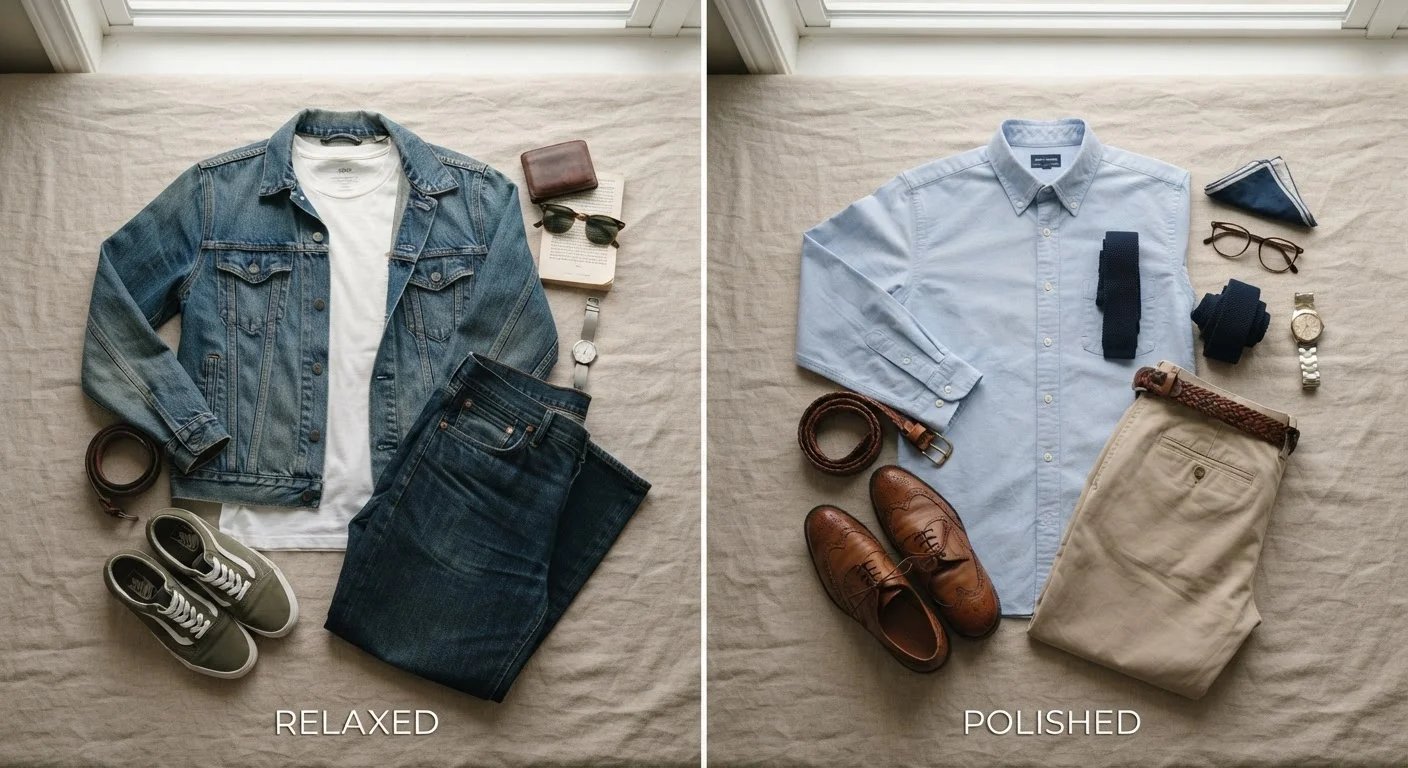
Casual dress in a workplace context typically means clothes chosen for personal comfort and expression rather than professional signaling. This can include clean denim, fitted t-shirts, sneakers, and relaxed knits. The key word is clean — even genuinely casual workplaces usually draw the line at distressed, stained, or athletic-wear-adjacent pieces.
Business casual sits one intentional step above that. It says: I dressed with this specific setting in mind. Common markers include collared shirts or structured blouses, chinos or neat trousers, dresses or skirts of a moderate length, and footwear that isn't primarily athletic. Fabrics tend to be more structured — cotton twill, ponte knit, light wool blends — rather than jersey or fleece.
| Criterion | Casual Dress | Business Casual |
|---|---|---|
| Typical bottoms | Any-wash jeans, joggers, shorts | Chinos, trousers, dark or neat denim |
| Typical tops | Graphic tees, hoodies, casual knits | Collared shirts, blouses, structured sweaters |
| Footwear | Sneakers, sandals, casual flats | Loafers, low heels, clean leather shoes |
| Fabric expectation | Jersey, fleece, denim, casual cotton | Twill, ponte, light wool, structured cotton |
| Fit priority | Comfort-first; relaxed or oversized accepted | Intentional fit; neither too baggy nor too tight |
| Distressing or logos | Often acceptable in moderation | Generally avoided |
One of the most practical ways to navigate both codes is through outfit formulas that take the guesswork out of getting dressed. A dark trouser paired with a clean blouse and a low-heeled shoe, for example, clears the business casual bar in almost every U.S. office without requiring a full suit.
The Details That Move an Outfit Between Codes
The difference between casual and business casual often lives in small, specific choices rather than the garment category itself. A crewneck sweater in a fine-gauge knit reads as business casual; the same silhouette in a thick fleece reads as casual. Dark, straight-leg jeans with no distressing inch close to business casual in many workplaces — while the same cut in a light wash with fraying sits firmly in casual territory.
The 'Smart Casual' Overlap
Some workplaces and invitations use the term 'smart casual,' which generally sits between casual and business casual. In practice, it often means: take your casual outfit and swap one element for something slightly more elevated — a neater shoe, a structured layer, or a more refined fabric. It's worth knowing this term exists on the spectrum, even if it's rarely defined explicitly.
Footwear carries more weight than most people expect. Clean leather or suede loafers and low-heeled boots anchor an outfit toward the business casual end. Fashion sneakers — especially in muted, monochromatic colorways — now occupy a gray zone that many offices accept, while sport or running sneakers still tend to register as casual or off-duty.
Fit is another decisive factor. How Clothing Fit Actually Works explains this in accessible detail, but the short version is: well-fitted clothes in simple cuts read as more intentional regardless of price point or category. An oversized or ill-fitting garment in technically business-appropriate fabric can still undercut a polished impression.
How to Read Your Specific Workplace
No national standard governs either dress code — which means the most reliable guide is observation. Spend your first week or two in a new role watching what people at your level and slightly above actually wear on regular workdays and on days with external meetings. Those two data points together map the practical range your workplace operates in.
If your workplace skews more expressive, Neutral Wardrobe vs. Colorful Wardrobe can help you think through how much personality to build into your rotation. A colorful outfit can absolutely be business casual — the code is about structure and intention, not palette.
83%
Workers who say dress codes affect confidence
A SHRM-affiliated workforce survey found a strong majority of employees believe their clothing choices directly influence how confident and competent they feel at work.
50%+
U.S. companies that relaxed dress codes post-2020
Research from multiple HR industry groups suggests more than half of American employers loosened or eliminated formal dress policies following the widespread shift to hybrid and remote work arrangements.
When genuine ambiguity remains, the practical default is to dress toward the more polished end until you've gathered enough information to calibrate downward. It's far easier to recover from slightly overdressing than from consistently underdressing in a professional setting.