

Key Takeaways
- Neutral wardrobes make getting dressed faster by reducing decision fatigue each morning.
- Colorful wardrobes can positively influence mood and communicate personality without words.
- Most people benefit from a hybrid approach rather than committing to one extreme.
- Your lifestyle, work environment, and personal energy level all shape which strategy fits better.
- Neither approach is inherently more stylish — both require intentionality to work well.
Option A
Neutral Wardrobe
The versatile, low-decision foundation.
Best for: People who want maximum outfit flexibility with minimal planning and a streamlined closet.
Option B
Colorful Wardrobe
The expressive, mood-forward choice.
Best for: People who use clothing as a form of self-expression and enjoy making visual impact daily.
If you want to get dressed quickly on busy mornings
Neutral Wardrobe
Neutrals mix and match almost automatically, cutting down the time and mental effort needed to assemble an outfit.
If clothing is a major form of self-expression for you
Colorful Wardrobe
Color is one of the fastest, most accessible ways to signal personality and mood — and it genuinely makes outfits feel more intentional.
If you work in a conservative or formal professional environment
Neutral Wardrobe
Neutrals read as polished across nearly all dress codes and require less mental energy to keep workplace-appropriate.
If you love creative fields or casual-forward lifestyles
Colorful Wardrobe
In environments where visual creativity is valued or dress codes are relaxed, color helps you stand out authentically.
If you're building your wardrobe from a limited budget
Neutral Wardrobe
Neutral pieces earn more cost-per-wear because they work with nearly everything you already own, stretching your dollars further.
What Each Strategy Actually Means
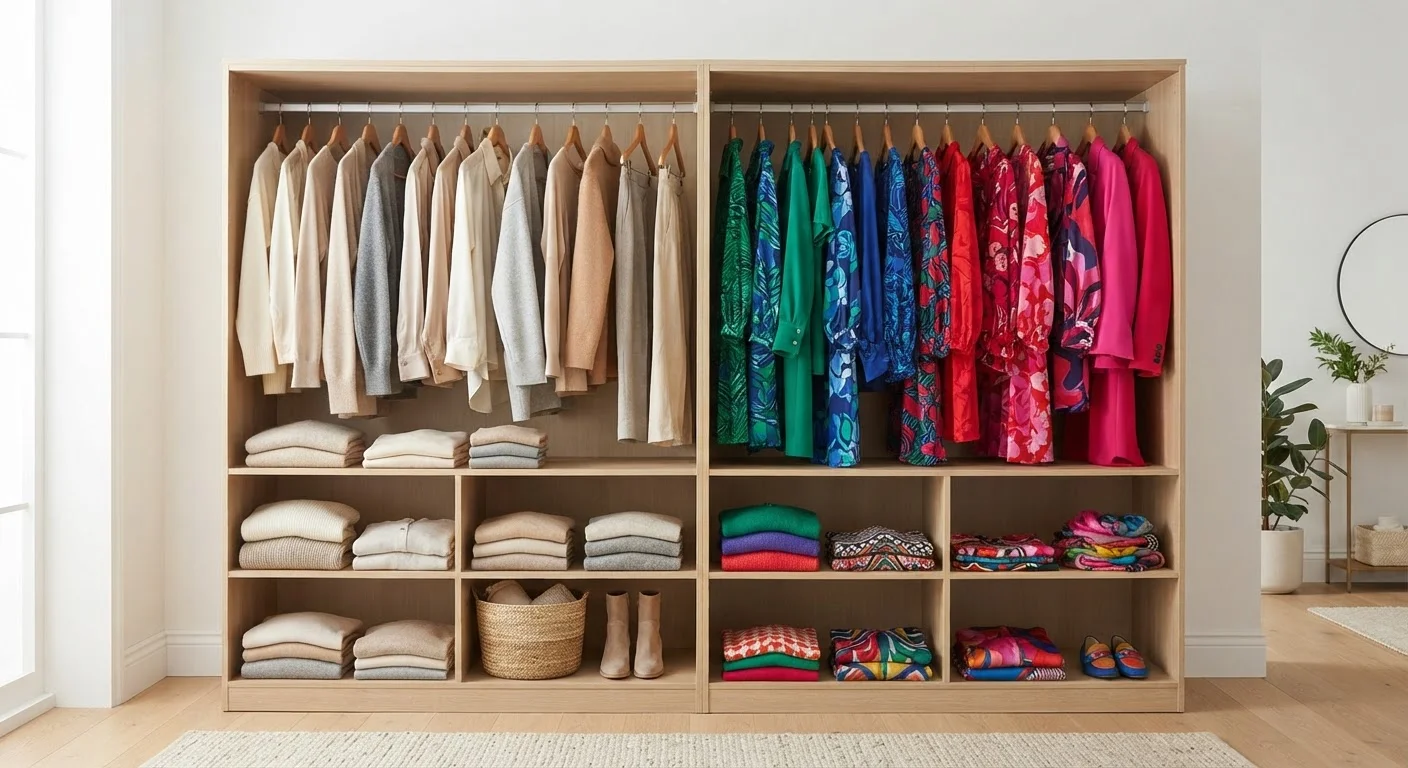
A neutral wardrobe is built around colors that don't compete — think white, cream, grey, black, navy, tan, and camel. The logic is structural: when everything can pair with everything else, the math of getting dressed gets dramatically simpler. Proponents of this approach often describe their closets as feeling calmer and more intentional.
A colorful wardrobe, by contrast, leans into hue as a design tool. That might mean bold brights, rich jewel tones, earthy terracottas, or even a well-curated palette of several complementary shades. The goal isn't chaos — it's vibrancy. Worn with intention, color communicates something before you've said a word.
Neither approach demands an all-or-nothing commitment. Most people naturally land somewhere on a spectrum. The question worth asking isn't "which is better?" but rather "which strategy actually supports my life right now?" If you're building your closet from scratch, this decision shapes nearly every purchase you'll make.
The Real Case for Going Neutral
The strongest argument for neutrals isn't aesthetic — it's cognitive. Decision fatigue is a well-documented phenomenon: the more choices you make early in the day, the less mental energy you have for everything else. A wardrobe built on neutrals reduces outfit decisions to nearly zero. Pull any top, any bottom, any layer — they'll likely work together.
There's also a practical cost-per-wear advantage. A well-made camel coat or a crisp white button-down earns its keep across seasons, years, and dozens of outfit combinations. That longevity makes neutrals a financially sensible backbone for any closet, especially if you're working with a realistic budget. This is central to the thinking behind capsule wardrobe systems, which almost universally recommend starting with neutrals.
Neutrals also tend to travel and transition well across dress codes. Whether you're navigating casual vs. business casual expectations at work or packing light for a trip, neutral pieces adapt more easily than bold statement colors.
| Criterion | Neutral Wardrobe | Colorful Wardrobe |
|---|---|---|
| Morning decision time | Minimal — pieces mix automatically | Higher — requires thoughtful pairing |
| Cost-per-wear potential | High — versatile across outfits | Varies — depends on how many combinations work |
| Self-expression | Subtle — expressed through fit and texture | Strong — color signals personality immediately |
| Mood impact | Calm, consistent, low-key | Energizing or expressive, day-dependent |
| Workplace adaptability | Broad — works across most dress codes | Context-dependent — varies by industry |
| Seasonal flexibility | High — neutrals work year-round | Moderate — some colors feel seasonal |
| Closet organization complexity | Low — easy to see what goes together | Higher — requires intentional curation |
The Real Case for Embracing Color
Color does something neutrals simply can't: it communicates mood, energy, and identity at a glance. Psychological research has long explored the relationship between color and emotional state, and while the connections are complex, many people report that wearing color they love genuinely affects how they feel throughout the day. That's not a small thing.
A colorful wardrobe also makes individual pieces more memorable and outfits more distinctive. If personal style matters to you — if getting dressed is something you actually enjoy rather than just tolerate — color is one of the fastest ways to make your closet feel like yours. It's also a natural entry point into pattern mixing, which adds another layer of visual interest once you understand the underlying logic.
The challenge with color isn't wearing it — it's organizing it. A colorful wardrobe that isn't well-considered can feel chaotic and actually make getting dressed harder, not easier. Strategic thinking about which colors genuinely work together in your collection is essential. The good news: you don't need every color to make this work. Even a focused palette of three to four well-chosen hues can create a wardrobe that feels vibrant without becoming overwhelming.
62%
Americans who say clothing affects their confidence
According to a survey by the American Psychological Association, a majority of respondents reported that what they wear influences how confident they feel during the day.
35+
Decisions the average person makes before 9 a.m.
Research on decision fatigue suggests that morning routines — including getting dressed — consume a meaningful share of daily cognitive bandwidth.
~30%
Of wardrobe items worn regularly by most people
Wardrobe utilization studies consistently find that most people regularly wear only a fraction of what they own, regardless of whether their closet leans neutral or colorful.
How to Decide What Works for Your Life
The most useful question isn't "Do I prefer neutrals or color?" — it's "What does my actual daily life demand of my clothes?" Consider your work environment, your social calendar, how much mental bandwidth you want to devote to getting dressed, and how much genuine joy your clothing brings you right now.
For most people, the answer is a hybrid: a neutral foundation that handles the functional, everyday lifting, with intentional color added through accessories, statement pieces, or a dedicated category like weekend wear. This approach captures the efficiency of neutrals while preserving the expressiveness of color. It also gives you flexibility as your life shifts — a seasonal wardrobe transition becomes much easier when the core stays stable.
If you're drawn to the idea of owning fewer, more versatile pieces, the trade-offs of a minimalist approach are worth understanding honestly before committing. And whatever direction you go, how you organize your closet will determine whether your strategy actually holds up in daily use.
Style isn't a problem to solve once — it's a system you adjust as you go. The best wardrobe strategy is the one you'll actually use.
There's No Universal Right Answer
Style advice that insists neutrals are "timeless" while color is "trendy" (or vice versa) is oversimplified. Both approaches have produced enduring, well-regarded personal styles across decades. What matters most is whether your wardrobe strategy reduces friction in your daily life and reflects who you actually are — not which aesthetic theory you subscribe to. Trust your own experience over any blanket rule.