

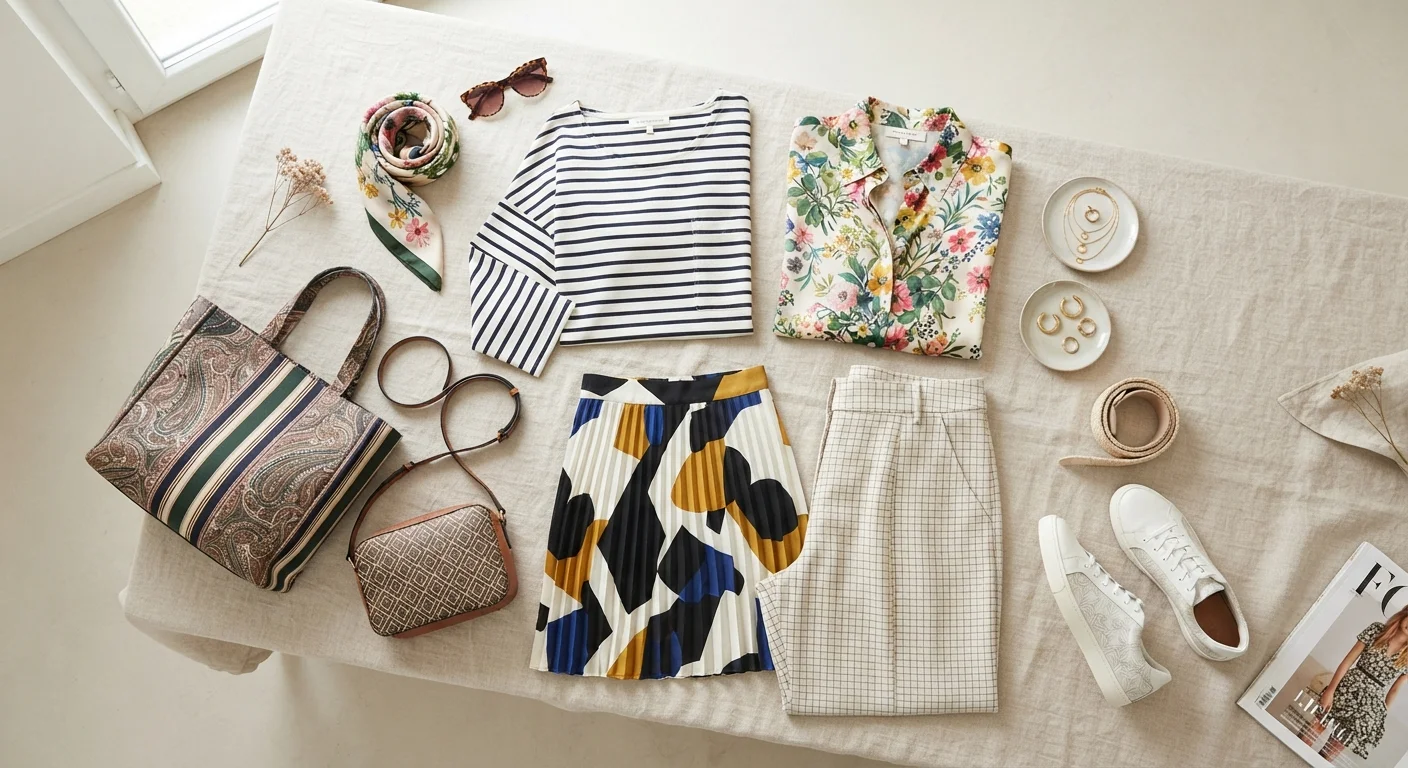
Key Takeaways
- Scale contrast is the single most reliable tool for mixing patterns successfully.
- Patterns that share at least one color create visual cohesion without looking overly matchy.
- Texture and fabric weight can either support or undermine a mixed-pattern outfit.
- Starting with two patterns is easier than three — master the pair before adding more.
- A solid anchor piece gives the eye a place to rest in a busy outfit.
What you will need
Why Pattern Mixing Trips People Up
Most people don't avoid mixing patterns because they dislike the look — they avoid it because it feels like a gamble. One wrong pairing and an outfit goes from intentional to chaotic. But that uncertainty usually comes from treating pattern mixing as intuition-only, when it's actually a skill with learnable logic.
The core problem is that our brains are pattern-recognition machines. When two patterns compete at the same visual frequency — same scale, similar geometry — they create a kind of optical noise. The eye can't settle. That's the feeling of an outfit that's "too much." But when patterns are calibrated so they don't fight each other, the brain reads them as harmonious rather than busy.
Many common fashion rules around pattern mixing are really just poorly articulated versions of this principle. Understanding the actual mechanism makes the whole thing far less stressful.
Start with Patterns You Already Own
Before buying anything new, pull out everything patterned in your closet and experiment on a flat surface or hanger. Most people discover they already own workable combinations they've never tried. Pattern mixing is often more about rearranging what you have than acquiring new pieces.
The Logic That Makes It Work
There are three variables that determine whether mixed patterns hold together: scale, color, and pattern type. You don't need all three to work perfectly — hitting two out of three usually gets you there.
Scale contrast
This is the non-negotiable. Pair a large-scale pattern with a small-scale one. A wide windowpane plaid with a tiny ditsy floral. A bold oversized stripe with a fine houndstooth. The size difference gives each pattern its own visual lane and prevents them from interfering with each other.
Shared color
Patterns that share even one color create an instant visual bridge. If your floral has navy in it and your stripe is navy-and-white, they read as part of the same outfit rather than two separate accidents. You don't need exact color matching — near-matches and tonal relatives usually work just as well.
Pattern type variety
Mixing pattern families — geometric with organic, structured with irregular — tends to work better than doubling up on the same type. Two bold florals compete. A floral with a stripe complement. Think of it as introducing contrast in category, not just scale.
If you prefer simpler outfit frameworks, reliable outfit formulas are a great foundation before layering in pattern play.
Prints on Prints Isn't Always the Goal
Not every outfit needs to lean into pattern mixing. If a look feels forced or you're spending more time second-guessing than getting dressed, a single statement pattern with solid companions is a completely valid — and often stronger — choice. Pattern mixing should add energy to an outfit, not anxiety.
How to Build a Mixed-Pattern Outfit Step by Step
Choose your dominant pattern first
Start with the pattern you want to lead the outfit — usually the one on your largest or most prominent piece. This sets the scale and color palette that everything else will respond to. If it's a large floral blouse, that's your anchor point.
Pick a second pattern at a noticeably different scale
Select a second patterned piece whose print is clearly larger or smaller than your first. There should be no ambiguity — if you have to look twice to determine which is bigger, the contrast isn't strong enough. A good rule of thumb: aim for at least a 2:1 difference in perceived print size.
Confirm a shared color between the two patterns
Hold the two pieces next to each other and identify at least one color they share. It doesn't need to be exact — a warm cream in one and an ivory in another can work. If there's genuinely no overlap, consider whether a solid in a bridging color can sit between them.
Add a solid anchor piece
Introduce at least one solid piece — a trouser, a shoe, a jacket, a bag — that matches one of the colors in your patterns. This creates visual relief and prevents the overall look from feeling relentlessly busy. The solid doesn't need to be neutral; a solid cobalt can anchor two patterns that share blue tones just as effectively.
Do a final mirror check for visual noise
Step back and look at the full outfit. Ask yourself: does the eye move around the outfit pleasantly, or does it snag somewhere and feel restless? If something feels off, the most common culprit is scale — try swapping one piece for a version with a more contrasting print size before changing anything else.
Once you're comfortable with two-pattern combinations, a third pattern can work — but it should be small in scale and subordinate in placement (a printed sock, a patterned belt, a scarf). Think of it as a supporting accent rather than a third lead.
For a broader look at building a wardrobe that supports this kind of experimentation, see our guide on neutral versus colorful wardrobe strategies — the approach you take there shapes how easily you can mix patterns day-to-day.
What Makes It Fall Apart
Even with good intentions, a few consistent mistakes derail mixed-pattern outfits:
- Same scale, different pattern: Two medium-scale prints worn together almost always clash. Scale contrast is the one rule that rarely has exceptions.
- No color connection: Patterns pulled from entirely different color worlds look like two outfits happening at once. Even a single shared neutral can anchor them.
- No solid rest point: An all-pattern outfit from head to toe overwhelms most looks. A solid shoe, bag, or layer gives the composition breathing room.
- Ignoring fabric weight: A delicate chiffon print and a heavy canvas print fight each other texturally, not just visually. Keeping fabrics in the same weight family helps the outfit hang and move cohesively.
Pattern mixing works best when it feels deliberate rather than accidental. If you can articulate why two patterns belong together — even if it's just "they share that rust color" — the outfit tends to read that way to others too.
Confidence Is Part of the Look
The biggest factor in whether a mixed-pattern outfit works is often how it's worn. An outfit you feel uncertain about reads differently than one you're committed to. If you've followed the logic — scale contrast, color connection, solid anchor — trust the result. Hesitation shows up in how you carry yourself, and that affects the read more than any pattern choice.