

Key Takeaways
- Smartwatches offer broader functionality including apps, calls, and mobile payments alongside health tracking.
- Fitness trackers focus on health and activity data, typically with simpler interfaces and longer battery life.
- Both device types now include heart rate monitoring, sleep tracking, and step counting as standard features.
- Smartwatches generally require more frequent charging, often daily, compared to multi-day tracker batteries.
- Your choice should hinge on how much you want your wrist device to replace your phone versus inform your health habits.
Option A
Smartwatch
The versatile, do-it-all wrist computer.
Best for: People who want smartphone-like functionality — notifications, apps, payments, and health tracking — on their wrist.
Option B
Fitness Tracker
The focused, no-fuss health monitor.
Best for: People whose primary goal is monitoring activity, sleep, and health metrics with minimal distraction and longer battery life.
If you want to stay connected without constantly pulling out your phone
Smartwatch
Smartwatches surface calls, messages, calendar alerts, and app notifications directly on your wrist, reducing phone dependency throughout the day.
If your main goal is tracking workouts, sleep, and daily activity
Fitness Tracker
Fitness trackers are purpose-built for health data, lightweight to wear around the clock, and typically last several days on a single charge.
If you want to pay for coffee or transit from your wrist
Smartwatch
Contactless payments (via NFC — short for Near Field Communication) are a smartwatch feature; most fitness trackers do not support it.
If battery anxiety is a real concern for you
Fitness Tracker
Many fitness trackers run five to fourteen days on a charge, making them far more forgiving if you forget to plug in nightly.
If you want advanced health sensors like ECG or blood oxygen monitoring
Smartwatch
Higher-end smartwatches more commonly include medical-adjacent sensors like ECG (electrocardiogram) and SpO2 (blood oxygen) monitoring, though these features are expanding into some trackers too.
How These Two Devices Actually Differ
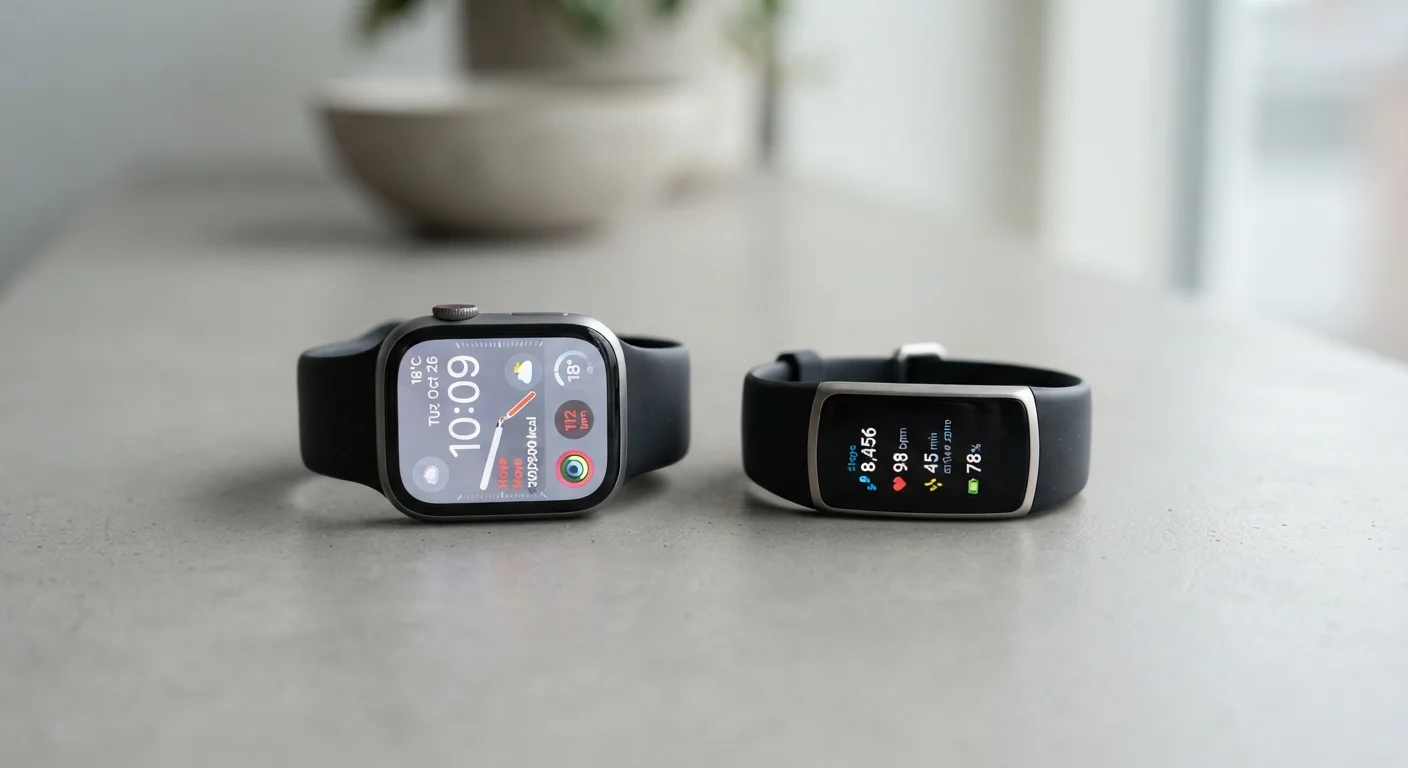
At a glance, a slim fitness tracker and a full smartwatch can look like variations of the same thing. Both sit on your wrist, both count steps, and both connect to your phone. But their underlying design philosophies point in very different directions.
A smartwatch is essentially a compact extension of your smartphone. It runs apps, handles notifications, and in many cases lets you make calls, send messages, or tap to pay — all without touching your phone. That versatility comes with trade-offs: a larger form factor, a more complex interface, and a battery that often needs charging every day or two.
A fitness tracker is built around a narrower mission: give you accurate, continuous health and activity data with as little friction as possible. The interface is usually simpler — a small display or no screen at all — and the battery can run for days or even weeks. You won't be downloading apps or replying to emails from your wrist, but you will get reliable step counts, heart rate trends, and sleep breakdowns without thinking about it.
For a deeper look at how these categories have evolved, see Fitness Tracker or Smartwatch: Understanding the Real Difference.
| Criterion | Smartwatch | Fitness Tracker |
|---|---|---|
| Primary purpose | Connectivity + health tracking | Health and activity monitoring |
| Typical battery life | 1–2 days | 5–14 days |
| App support | Full third-party apps | Limited or none |
| Notifications | Full smartphone notifications | Basic alerts only |
| Contactless payments (NFC) | Common | Rare |
| GPS | Usually built-in | Varies; sometimes connected GPS |
| Sleep tracking | Yes, with caveats around charging | Yes, easier due to battery life |
| Form factor | Larger, heavier display | Slim, lightweight band |
| Price range | Generally higher | Generally lower to mid-range |
Where They Overlap — and Why That Matters
The line between the two categories has blurred considerably. Mid-range fitness trackers now display smartphone notifications and support GPS (Global Positioning System, meaning the device tracks your route using satellite signals). Many smartwatches, meanwhile, have become serious health monitors with sensors that track heart rate variability, sleep stages, blood oxygen levels, and even irregular heart rhythm detection.
This overlap means neither category has a monopoly on health features. The practical question is less which one tracks more and more which set of features will you actually use day to day?
~30%
Wearable owners who use fewer than half the device's features
Industry research consistently finds a significant portion of wearable owners engage with only a fraction of their device's available functionality.
5–14 days
Typical fitness tracker battery range
Most dedicated fitness trackers are designed for multi-day use without charging, compared to the daily or near-daily charging common with full smartwatches.
If you tend to ignore notifications and primarily want to understand your activity and sleep patterns, a fitness tracker's focused experience may serve you better — even if a smartwatch technically does more. On the other hand, if you find yourself reaching for your phone constantly, a smartwatch can genuinely reduce that habit. For more on which smartwatch features people end up skipping, see The Smartwatch Features Most People Never End Up Using.
Battery Life, Comfort, and Daily Wearability
Battery life is one of the most practical differentiators. Many smartwatches need to be charged nightly, which means you lose sleep-tracking data unless the battery lasts through the night — or you remember to charge during the day. Fitness trackers commonly last five to fourteen days, making them far easier to wear continuously without building a charging routine around them.
Form factor matters too. Fitness trackers tend to be lighter and slimmer, which makes them more comfortable for all-day and all-night wear. Smartwatches have improved here, but their larger displays and additional hardware generally mean a bulkier profile.
If battery behavior is a key factor in your decision, it's worth understanding what quietly drains a wearable's power: Why Your Smartwatch Battery Dies Faster Than Advertised breaks down the main culprits.
Smartwatch Setup Requires a Bit More Work
Smartwatches typically need a companion app installed on your phone, account creation, and permission grants before they function fully. Fitness trackers generally follow the same process, though the setup tends to be simpler. If you're new to wearables, Pairing a Wearable with Your Smartphone: Getting the Setup Right walks through what to expect.
Before committing to either device type, it's also worth running through compatibility considerations — whether the device works with your phone's operating system, which app it requires, and how waterproof it actually is. Things Worth Checking Before You Commit to a Wearable Device provides a practical checklist for exactly that.
Making the Call: Questions to Ask Yourself
Rather than choosing based on specs alone, it helps to anchor the decision in how you actually live:
- Do you want wrist-based connectivity? If replying to a text or checking a calendar reminder from your wrist sounds genuinely useful, a smartwatch fits that need. If it sounds distracting, a tracker's limited notifications may feel like a feature, not a limitation.
- How serious is your fitness tracking? Casual walkers and people focused on general wellness often find a fitness tracker more than sufficient. If you follow structured training plans or want detailed workout metrics, it's worth checking which sensors and sport modes each device category supports — see What to Check Before Choosing a Fitness Tracker for a feature checklist.
- Will you wear it to bed? Sleep tracking is most useful when it's consistent. If nightly charging makes that difficult, a long-battery tracker has a real advantage. Wearable Sleep Tracking: How It Works and What to Do With the Data explains what the data actually means once you have it.
- What does your phone ecosystem look like? Some smartwatches work most fully with a specific phone platform. A fitness tracker is generally more platform-agnostic, though the companion app experience still varies.
There's no universally correct answer here — the right wearable is the one you'll actually put on every morning without thinking twice about it.