
True Wireless Earbuds vs. Wired Headphones: What Changes for Everyday Listening

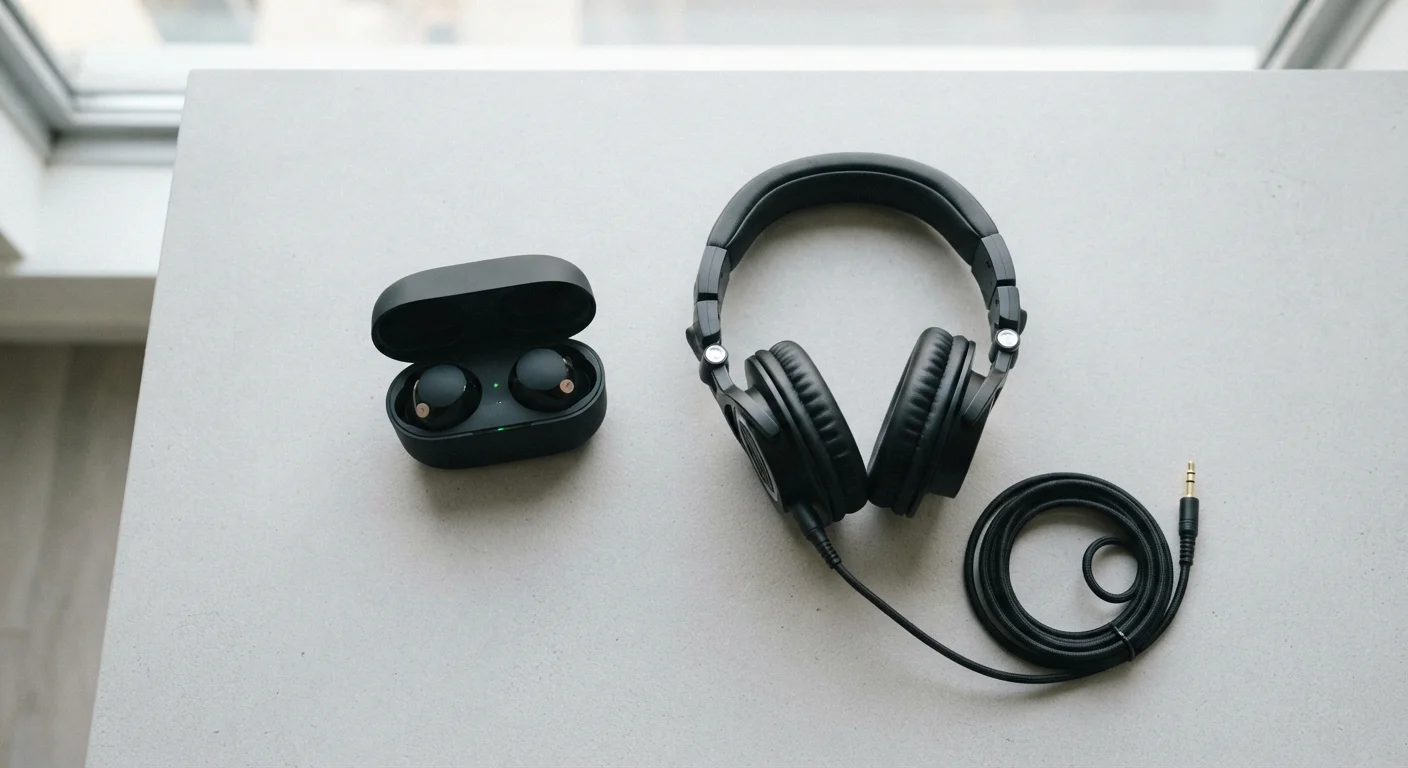
Key Takeaways
- True wireless earbuds eliminate cables but introduce battery management as a daily consideration.
- Wired headphones deliver consistent audio quality without pairing steps, latency, or charging.
- Bluetooth audio compression can subtly affect sound quality compared to a direct wired connection.
- Earbuds are more portable; wired headphones are often more comfortable for long listening sessions.
- Replacing or repairing wired headphones is generally simpler and less expensive than replacing wireless earbuds.
- Neither option is universally better — the right choice depends on where and how you listen.
Option A
True Wireless Earbuds
The cable-free, go-anywhere listening option.
Best for: Commuters, active users, and anyone who wants minimal bulk and maximum portability.
Option B
Wired Headphones
The reliable, no-charging-required audio staple.
Best for: Home listeners, remote workers, and anyone who prioritizes consistent audio quality without battery anxiety.
If you commute daily or frequently listen on the move
True Wireless Earbuds
No cable snagging, easy pocket storage, and hands-free call handling make earbuds a natural fit for mobile routines.
If you work from home and listen for several hours at a stretch
Wired Headphones
No battery to manage and a direct connection means one less interruption during long focus sessions or video calls.
If audio fidelity matters and you use a dedicated audio source
Wired Headphones
A wired connection bypasses Bluetooth compression entirely, which matters when using higher-quality audio files or a DAC.
If you exercise or listen during physical activity
True Wireless Earbuds
Earbuds stay out of your way during movement, and many are rated for sweat or light rain resistance.
If you're on a tight budget and want long-term reliability
Wired Headphones
Wired options involve no battery degradation over time, and a frayed cable is typically cheaper to fix than replacing a wireless earbud.
How Each Format Actually Works
True wireless earbuds — often abbreviated as TWS — connect to your phone or computer via Bluetooth, a short-range radio standard that streams audio without a physical cable. Each earbud is a self-contained unit with its own battery and onboard chip that decodes the audio signal. The charging case doubles as a portable battery, topping up the earbuds between uses.
Wired headphones work differently. They receive an analog audio signal directly from the source device through a 3.5mm headphone jack or, in some setups, a USB-C or Lightning connector with a built-in digital-to-analog converter (DAC). There's no battery, no pairing process, and no wireless signal to manage. Plug in and it works.
Understanding that basic difference — radio signal versus direct wire — explains most of the practical trade-offs between the two formats. For a broader look at how form factor shapes your daily experience, see our guide on over-ear vs. in-ear headphone trade-offs.
| Criterion | True Wireless Earbuds | Wired Headphones |
|---|---|---|
| Cable required | No | Yes |
| Battery needed | Yes (5–8 hrs per charge) | No |
| Audio compression | Yes (Bluetooth codec) | None (direct signal) |
| Latency | Slight (codec-dependent) | Effectively none |
| Portability | Very high | Moderate |
| Setup per use | Auto-pair after initial setup | Plug in and play |
| Long-term durability | Battery degrades over time | Can last many years |
| Repairability | Limited; often replace unit | Cable often replaceable |
Sound Quality: What the Wire Actually Buys You
Wired headphones deliver audio without compression — the signal travels as-is from source to driver. Wireless earbuds, by contrast, must compress audio to transmit it over Bluetooth. The codec (the software standard used to encode and decode that audio) determines how much quality is lost. Common codecs like SBC are fine for casual listening; higher-quality codecs like aptX or AAC reduce the quality gap noticeably, but a small gap generally remains versus a direct wired connection.
For most everyday listening — podcasts, playlists, background music — that difference is not meaningful. It becomes more noticeable if you're using lossless audio files, playing an instrument alongside a track, or using studio-quality source equipment. In those contexts, wired connections have a clear advantage.
~20ms
Typical Bluetooth audio latency
Bluetooth SIG technical specifications indicate modern Bluetooth audio typically introduces around 20–100ms of latency depending on the codec used.
2–4 years
Typical earbud battery lifespan
Lithium-ion battery performance generally declines meaningfully after 300–500 full charge cycles, per widely cited battery industry standards.
328 ft
Maximum Bluetooth 5.0 range
Bluetooth 5.0 supports up to 100 meters in open-air conditions; real-world performance inside buildings is significantly shorter due to interference.
Latency — the slight delay between audio and video — is another practical concern with Bluetooth. Most modern wireless earbuds handle it well enough for video calls and streaming, but very low-latency applications like mobile gaming can still expose timing issues that a wired connection avoids entirely.
Convenience, Portability, and Daily Friction
This is where wireless earbuds clearly pull ahead for many users. No cord means no tangling in a bag, no snagging on a jacket zipper, and no fumbling with a headphone jack on a device that may not have one. Pairing a set of earbuds to a phone takes seconds and usually happens automatically once set up.
That said, convenience cuts both ways. Earbuds need to be charged — typically offering five to eight hours of listening time per charge, with the case adding two or three full recharges. Forget to charge them and you're stuck. Wired headphones, by contrast, are always ready. Plug them in, listen. There's no app to open, no firmware to update, no pairing to troubleshoot.
If Bluetooth connectivity issues are a recurring frustration, our explainer on why wireless headphones disconnect breaks down the common causes and fixes. And if you're choosing earbuds specifically for workouts, the feature priorities shift further — earbuds for running covers what actually matters in that context.
Noise Cancellation Is a Separate Feature
Active noise cancellation (ANC) — which uses microphones to counteract ambient sound — is available on both wireless earbuds and some wired headphones. It's not a wireless-only feature, and its presence or absence is independent of whether the headphones use a cable. If noise isolation is a priority, check our guide on active vs. passive noise cancellation for a plain-language breakdown of how each approach works.
Long-Term Cost and Durability
Wired headphones have a straightforward durability story. If a cable frays, it can often be replaced at low cost or repaired. The headphones themselves — no battery, no wireless chip — tend to age well. A well-built wired pair can remain fully functional for many years.
Wireless earbuds involve lithium-ion batteries that degrade with charge cycles. After two to four years of regular use, battery capacity typically drops noticeably. Replacing the earbuds outright is often the only practical path, as battery replacement for small earbuds is rarely feasible.
Initial cost varies widely in both categories, but at comparable price points, wired headphones often deliver stronger build quality and longer usable life. For tips on extending the life of either type, see our guide on caring for earbuds and headphones. Before buying wireless, it's also worth avoiding some common missteps — eight things people get wrong when buying wireless earbuds is a useful checkpoint.