

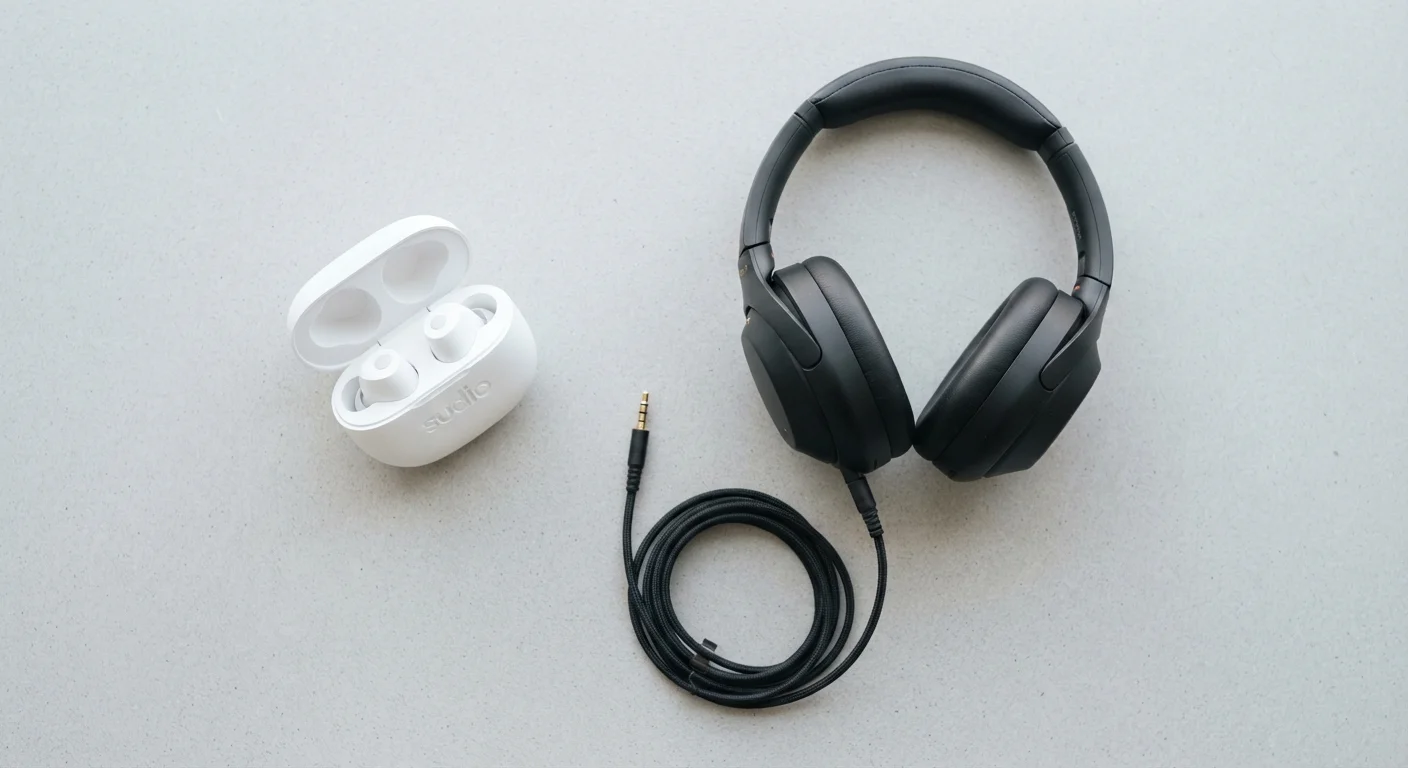
Key Takeaways
- True wireless earbuds eliminate cables but introduce battery management as a daily responsibility.
- Wired headphones deliver consistent audio with no charging required, but restrict movement and device compatibility.
- Active noise cancellation is available on both types, but implementation and battery cost differ significantly.
- Bluetooth audio adds a compression step that wired connections avoid, which matters most at higher listening volumes.
- Comfort and fit vary widely within each category — form factor alone doesn't determine which suits you.
Option A
True Wireless Earbuds
The cable-free, carry-anywhere option.
Best for: Commuters, gym-goers, and anyone who wants audio without a cord getting in the way.
Option B
Wired Headphones
The plug-in, always-ready classic.
Best for: Home listeners, remote workers, and audiophiles who prioritize consistent sound quality over portability.
If you commute or exercise regularly
True Wireless Earbuds
No cable to snag, small enough to pocket, and most models offer water resistance suited to sweat and light rain.
If you work from home and sit at a desk for long sessions
Wired Headphones
No battery anxiety, typically more comfortable over extended wear, and zero wireless interference to worry about.
If you frequently switch between multiple devices
True Wireless Earbuds
Multi-point Bluetooth pairing on modern earbuds lets you switch between a phone and laptop without re-pairing each time.
If audio quality at higher volumes is your priority
Wired Headphones
A direct analog connection skips the Bluetooth compression step, preserving more detail in music at louder listening levels.
If you tend to lose or misplace small accessories
Wired Headphones
A single connected unit is far harder to misplace than two independent earbuds that each need their own charging case slot.
The Core Difference: Connection Type and What It Costs You
The fundamental split between true wireless earbuds and wired headphones comes down to how audio reaches your ears — and every practical difference follows from that. Wired headphones use a physical cable to carry an analog audio signal directly from your device. True wireless earbuds (often called TWS earbuds) receive audio over Bluetooth, a short-range wireless protocol that compresses audio into a digital signal for transmission.
That compression step is worth understanding. Bluetooth codecs — the encoding formats used to transmit audio wirelessly — include standards like SBC, AAC, aptX, and LDAC. Each handles audio quality differently, with some preserving more detail than others. Even so, the gap between a good Bluetooth codec and a wired connection is most noticeable to careful listeners at higher volumes. For casual listening — podcasts, background music, calls — most people won't hear the difference. For a deeper look at how disconnections and interference affect wireless audio day-to-day, see why wireless audio cuts out.
| Criterion | True Wireless Earbuds | Wired Headphones |
|---|---|---|
| Connection | Bluetooth (wireless) | Physical cable (analog) |
| Battery required | Yes — earbuds + case | No (unless ANC-equipped) |
| Audio compression | Yes — Bluetooth codec | None — direct signal |
| Device compatibility | Any Bluetooth device | Requires jack or adapter |
| Portability | Very high — fits in pocket | Moderate — requires bag |
| Water resistance | Common (IPX4+) | Rare — mostly indoor use |
| Long-session comfort | Variable — ear fatigue possible | Generally better over hours |
| Risk of loss | Higher — two small units | Lower — single connected item |
Battery Life, Charging, and the Reliability Gap
Wired headphones require no power source of their own (unless they include active noise cancellation). You plug them in and they work — indefinitely. That reliability is easy to undervalue until you pick up your earbuds on a rushed morning and find them at 12%.
True wireless earbuds typically offer four to eight hours of playback per charge, with their charging case providing two to four additional top-ups. That math works out to a full day of listening for most users, but it requires remembering to return earbuds to the case between sessions. Battery degradation over time is also a real factor: lithium-ion cells lose capacity with each charge cycle, and most earbuds show reduced battery performance after 18–24 months of regular use.
4–8 hrs
Typical earbud playback per charge
Most true wireless earbuds on the market offer this range per charge cycle, with the case providing additional top-ups.
~30%
Battery drain increase with ANC enabled
Active noise cancellation can reduce wireless earbud battery life by roughly a third depending on the model and ANC intensity.
18–24 mo
When lithium-ion battery degradation becomes noticeable
Lithium-ion cells in earbuds typically show meaningful capacity loss within this window under regular daily charging cycles.
If battery health and longevity matter to you, proper habits extend the life of either type significantly. Good care habits around storage, charging, and cleaning apply to both categories.
Noise Isolation and Cancellation: Different Approaches
Both earbuds and wired headphones can block out environmental noise, but they go about it differently. Passive isolation — physically blocking sound with the ear cup or ear tip material — depends heavily on fit. Over-ear wired headphones with padded cups often provide strong passive isolation without any active electronics. In-ear earbuds seal the ear canal directly, which can also be highly effective when the ear tip fits correctly.
Active noise cancellation (ANC) uses microphones to detect ambient sound and generate an opposing signal that neutralizes it before it reaches your ears. ANC is now common in both wireless earbuds and wired headphones (the latter requiring a battery or powered source). On wireless earbuds, running ANC draws additional power and noticeably reduces battery life — sometimes by 30% or more depending on the model. How active and passive noise cancellation differ is worth understanding before choosing based on that feature alone.
Everyday Fit, Comfort, and Practical Convenience
Form factor shapes daily experience more than most spec sheets suggest. True wireless earbuds are compact, pocketable, and don't require a headphone jack — which matters since many modern smartphones have eliminated the 3.5mm port. They work with any Bluetooth-enabled device and are generally sweat- and splash-resistant, making them practical for workouts. For more on what specs actually count during physical activity, see what to look for in earbuds for running.
Wired headphones, by contrast, connect to anything with a headphone jack or adapter, never need pairing, and don't drop connection mid-song. Over long sessions — several hours of work or study — many users find over-ear wired headphones more comfortable than in-ear options, since ear canal fatigue is a real factor with extended earbud use.
No Headphone Jack? You're Not Alone
Many current smartphones no longer include a 3.5mm headphone port, which means wired headphones require a USB-C or Lightning adapter to connect. These adapters generally work well, but add a component to manage and occasionally lose. If your primary device lacks a headphone jack, factor in adapter reliability when comparing the two formats.
If you're weighing the comfort and sound differences between over-ear and in-ear designs more broadly, this breakdown of over-ear vs. in-ear trade-offs covers those distinctions in detail. And before you commit to wireless earbuds specifically, it's worth knowing the common mistakes shoppers make when buying wireless earbuds — details like codec support and ear tip sizing trip up a lot of first-time buyers.