
Digital Tools vs. Physical Labels: Managing Home Organization Without Overthinking It

Key Takeaways
- Digital tools excel at searchability and remote access but require consistent upkeep to stay useful.
- Physical labels work immediately without any learning curve and are readable by every household member.
- A hybrid approach - digital for inventory, physical for point-of-use labels - works well for many households.
- The best system is the one your whole household will actually maintain over time.
- Neither approach requires expensive equipment or subscriptions to be effective.
Option A
Digital Tracking Tools
The flexible, searchable, always-with-you option.
Best for: Tech-comfortable households that want centralized, shareable organization across multiple rooms or people.
Option B
Physical Labels & Paper Systems
The tactile, no-login, instantly readable approach.
Best for: Households that prefer low-tech, visible cues that anyone - including kids or older family members - can use without instruction.
If you manage a large home with many storage zones
Digital Tracking Tools
Digital systems let you search across rooms instantly and share lists with family members, making it easier to track what's stored where without walking the whole house.
If children or older adults share your space
Physical Labels & Paper Systems
Physical labels require no device, no password, and no app - anyone can read a bin label at a glance, making the system self-explanatory for all ages.
If you frequently reorganize or move items around
Digital Tracking Tools
Updating a digital record is faster and cleaner than re-labeling containers, and there's no adhesive residue left behind.
If you want minimal setup and immediate results
Physical Labels & Paper Systems
A label maker or even handwritten tags can be applied in minutes with zero onboarding, making them ideal for quick weekend organization projects.
If your household has mixed tech comfort levels
Physical Labels & Paper Systems
A system only works if everyone uses it. Physical labels don't exclude members who are less comfortable with apps or smartphones.
What Each Approach Actually Involves
When people talk about digital tracking tools for home organization, they typically mean apps for inventory management, shared notes (like a household shopping or storage list), spreadsheets, or home-management platforms. These tools let you log what you own, where it lives, and sometimes when it was purchased or needs to be replaced.
Physical labels and paper systems cover everything from a basic label maker and adhesive tags to color-coded dot stickers, chalkboard labels, index card files, and hand-lettered bin markers. The defining feature is that the information lives on the object or container itself - no device required.
Understanding the vocabulary behind both approaches can help. If terms like "negative space" or "one-in-one-out rule" come up as you plan your system, our plain-English home organization glossary covers those concepts clearly.
| Criterion | Digital Tools | Physical Labels |
|---|---|---|
| Setup time | Moderate - requires data entry | Quick - label and go |
| Searchability | High - keyword search across all items | Low - must check each location |
| Accessibility for all users | Limited - requires device access | Universal - no device needed |
| Ease of updating | Easy - edit records digitally | Variable - may need re-labeling |
| Cost | Free to low (many apps are free) | Low (label maker or handwritten) |
| Works without internet | Depends on the app | Always - fully offline |
| Visual, at-a-glance clarity | Low - stored in a device | High - visible on the container |
| Suited for shared households | Yes, if everyone uses the app | Yes - no coordination needed |
Where Digital Tools Have a Real Edge
Digital systems shine in a few specific situations. If your home has many storage zones - a basement, attic, garage, and multiple closets - a searchable digital inventory lets you find items without opening every bin. You type "Halloween decorations" and the app tells you which shelf in which room. That's a genuine time-saver.
Shared access is another strength. When two people manage a household, a shared digital list means both partners see updates in real time. Our article on organizing a home with a partner or roommate explores why shared systems matter for households with different tidiness standards.
Digital tools also handle change gracefully. If you reorganize a closet, updating a record takes seconds - no peeling labels, no residue, no re-printing.
~60%
U.S. adults who use smartphones daily for task management
Pew Research Center surveys consistently show the majority of American adults rely on smartphones for organizing daily tasks, suggesting digital tools have broad but uneven adoption.
1 in 3
Households reporting disorganization affects daily routines
Consumer surveys on home habits suggest roughly a third of households say clutter or poor storage systems create friction in everyday life.
Where Physical Labels Hold Their Ground
Physical labels have one unbeatable quality: they work without a middleman. No app to open, no battery to charge, no login to remember. A clearly labeled bin communicates its contents to anyone who walks past - including young children, houseguests, or family members who don't share your phone or app account.
This immediacy matters most in high-traffic areas. Kitchen cabinets, pantry shelves, bathroom drawers, and toy storage bins benefit from labels that can be read at a glance during a busy morning. The system doesn't rely on anyone's memory of where they logged the information.
Physical systems also tend to reinforce habits. When a container is labeled, it creates a natural return point - the label tells you and everyone else where the item belongs. This supports the kind of consistent maintenance that keeps organizing efforts from falling apart over time.
For households with children, physical labels are particularly practical. Our piece on organizing with children at home outlines why visual, tactile cues tend to outlast purely digital approaches in family settings.
A Note on Hybrid Systems
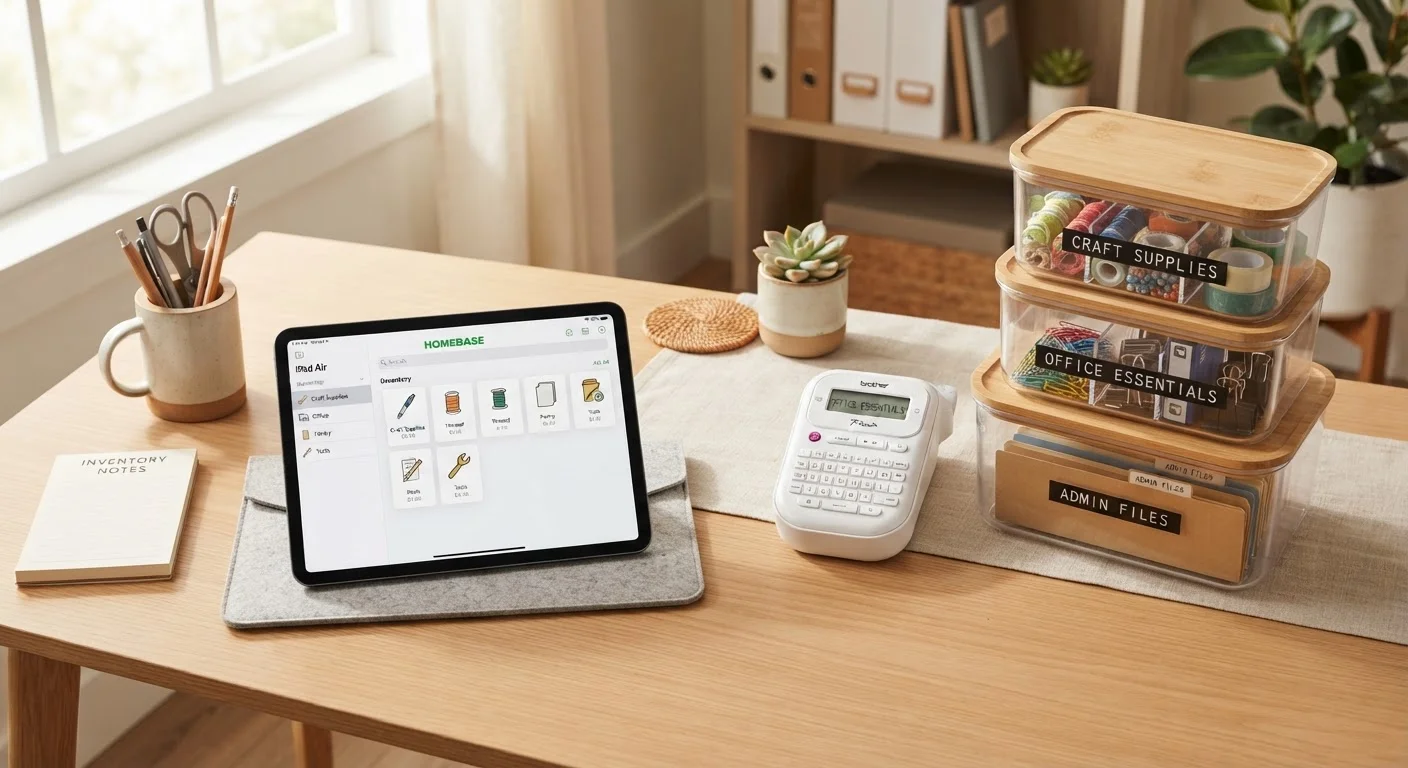
Many organizing professionals suggest that physical and digital methods aren't mutually exclusive. You might label everyday storage bins with a physical marker while maintaining a digital log of what's in seasonal or deep-storage bins in a closet or garage. Starting with one method and layering the other in gradually - rather than overhauling everything at once - tends to produce more durable results.
Choosing What Actually Works for Your Household
The most common mistake in home organization is choosing a system that looks good on paper but doesn't match how your household actually moves through a day. A detailed digital inventory is only useful if it gets updated. A label maker only helps if people return items to labeled spots.
A practical starting point: use physical labels for point-of-use storage - the places you reach into daily - and digital records for deep storage like seasonal bins, spare parts, or archival items you rarely access but need to locate occasionally. This hybrid approach draws the strengths from both methods without demanding that one system do everything.
For households wrestling with how rooms and storage zones connect, a room-by-room organization walkthrough can help you map out where each type of system makes the most sense before you commit to supplies or setup time.
The parallel to budgeting methods is worth noting: much like the debate between tracking spending by hand versus using an app, the right organization method is whichever one your household will actually sustain - not whichever one is theoretically more sophisticated.